Adult Court Process

In the case outlines that follow, each party is represented by an attorney. But this often is not the case, especially in limited jurisdiction courts. People may represent themselves in court without an attorney as long as they follow court rules. They often are called pro per, pro se, or self-represented litigants.

While this guide is intended to give a general overview of the Arizona court system and its procedures, not all cases proceed as outlined here.


Case Processing in Limited Jurisdiction Courts

Limited jurisdiction courts usually process criminal cases as follows:
  1. Initial Appearance – This is the defendant’s first appearance in court, and the defendant is advised of the charges. The judge appoints an attorney if the defendant cannot afford one.
  2. Arraignment – The defendant appears in court to enter a plea of guilty or not guilty. Many limited jurisdiction courts combine the initial appearance and the arraignment.
  3. Trial – If the defendant pleads not guilty, a trial is held. The judge—or at the defendant’s request, a jury—can hear evidence on the charges and find the defendant guilty or not guilty.
  4. Sentencing – If the defendant is found guilty, the court imposes the appropriate punishment (sentence).
  5. Appeals – Appeals from decisions of limited jurisdiction courts go to superior court. An appeal may be heard as a new trial (a trial de novo), or the superior court judge may review records of trial proceedings if records have been kept. Decisions made in small claims court cannot be appealed.


Superior Court Case Processing

In superior court, the two major types of court cases are criminal and civil. Trials in criminal and civil cases are generally conducted the same way. After all the evidence has been presented and the judge has explained the law related to the case to a jury, the jurors decide the facts in the case and render a verdict. If there is no jury, the judge makes a decision on the case.


Criminal Cases

Criminal cases involve the commission of acts that are prohibited by law and are punishable by probation, fines, imprisonment—or even death. The attorney representing the state, county or municipal government that formally accuses a person of committing a crime is the prosecutor. The person charged with the crime is the defendant.  The judge not only ensures that the rights of defendant are respected, but also the Constitutional provision and the statutorily required rights afforded to victims of crime.

1. Arrest – A person is arrested by a law enforcement officer who either sees a crime happen or has a warrant for arrest when probable cause exists that a person committed a crime. When a person is arrested, the person must be brought before a judge for an initial appearance within 24 hours of being arrested or else          be released.

2. Initial Appearance – At the initial appearance, the judge determines the defendant’s name and address, informs the defendant of the charges and of the right to remain silent and to have an attorney. The judge appoints an attorney if the defendant cannot afford one and sets the conditions for release from jail.

3. Preliminary Hearing – If a preliminary hearing is held, the judge hears evidence and testimony from witnesses called by the prosecuting attorney and the defendant’s attorney. If the judge determines there is enough evidence to believe the defendant probably committed the crime, the defendant is held for trial in
superior court, and an arraignment date is set.

4. Arraignment – At the arraignment, the defendant enters a plea of guilty, not guilty, or no contest (nolo contendere). If the defendant enters a not guilty plea, the judge will set a trial date. If the defendant enters a guilty plea or declares no contest to the charges, the judge will set a date to sentence the defendant for the           crime.

5. Trial
Opening Statements – The defendant has the right to a trial in which either a jury or the judge determines guilt. When the court is ready for the trial to begin, each side can make an opening statement. In a criminal case, the prosecuting attorney speaks first.

To begin, the prosecuting attorney gives an overview of the facts that will be presented. The defense attorney may present the same type of opening comment or may save the opening statement until later in the trial when that side of the case begins. Either attorney may decide not to give an opening statement.
Witnesses – The prosecuting attorney begins the case by calling witnesses and asking them questions. This is direct examination.

Witnesses in all trials take an oath or an affirmation that what they say in court is true. All trial evidence, including testimony and physical evidence, such as documents, weapons, or articles of clothing, must be acceptable as defined by the Arizona Rules of Evidence before it can be admitted into evidence and shown to the jury. The judge decides what evidence and testimony are admissible under the rules.

In a criminal trial, the prosecuting attorney presents evidence and witness testimony to try to prove beyond a reasonable doubt that the defendant committed the crime. The defendant’s attorney may present evidence and witnesses to show that the defendant did not commit the crime or to create a reasonable doubt as to the defendant’s guilt. The defendant is considered innocent of the crime charged until proven guilty.

When the prosecution has finished questioning a witness, the defense is allowed to cross-examine the witness on any relevant matter. After cross-examination, the attorney who first called the witness may ask the witness more questions to clarify something touched on in the cross-examination. This is redirect examination. The judge may allow an opportunity for the opposing attorney to re-cross examine.

When the prosecution has called all the witnesses for its side of the case and presented all of its evidence, it rests its case.

At this point, the defendant’s attorney may ask for a judgment of acquittal. This means that the attorney is asking the court to decide the case in the defendant’s favor because the prosecuting attorney did not present enough evidence to prove the case against the defendant. If the judge agrees that there is not enough evidence to rule against the defendant, the judge rules in favor of the defendant, and the case ends.

If a judgment of acquittal is not requested or if the request is denied, the defense may present evidence for its side of the case. The defense attorney often waits until this point in the trial to make an opening statement.

The defense may choose not to present evidence, as it is not required to do so. The defendant in a criminal case is not required to prove innocence. The burden is on the prosecution to prove the defendant’s guilt beyond a reasonable doubt.

If the defense does present a case and call witnesses, the same rules and procedures that governed presentation of evidence by the prosecution now apply to evidence presented by the defense including the opportunity for the prosecutor to cross-examine defense witnesses.

At the end of the defendant’s case, the prosecutor may present additional information to respond to evidence offered by the defense. Following this, the defense is given another opportunity to present more evidence on the defendant’s behalf.

Closing Arguments – After the prosecution and the defense have presented all of their evidence, each side may make closing arguments. Closing arguments—similar to opening statements—provide an opportunity for the attorneys to address the judge or the jury a final time. The prosecutor speaks first, usually summarizing the evidence that has been presented and highlighting items most beneficial to the prosecution. The defendant’s attorney speaks next. The defense attorney usually summarizes the strongest points of the defendant’s case and points out flaws in the prosecutor’s case. The prosecutor then has one last opportunity to speak.

Instructing the Jury – After closing arguments in a jury trial, the judge reads instructions to the jurors, explaining the law that applies to the case. Jury members must follow these instructions in reaching a verdict.

Jury Deliberations – The jury goes to a special jury room and elects a foreman to lead the discussion. Jurors must consider all of the evidence presented, review the facts of the case, and reach a verdict. When the jury makes its decision, the court is called back into session.

Verdict – The foreman presents a written verdict to the judge, and either the judge or the court clerk reads the jury’s verdict to the court. The court then enters a judgment based on the verdict, and the jury is released from service. If found not guilty, the defendant is released immediately. If the defendant is found guilty, a date is set for sentencing.  The defendant may be held in custody or remain on release status until sentencing.

Sentencing – A sentencing hearing is scheduled to determine the punishment a convicted defendant will receive. The judge hears testimony from the prosecution and the defense regarding the punishment that each side feels the convicted defendant should receive.

In Arizona, the Legislature has established a range of sentences for different crimes, and the judge must impose a sentence within the range outlined by law. The options may include probation, fines, imprisonment, or a combination of these punishments. In some cases, the death penalty can be imposed.  A jury rather than the judge is required to decide whether the defendant will receive the death penalty.

Appeals – A convicted defendant may appeal. If the death penalty has been imposed, an automatic appeal is filed with the Supreme Court. The Court of Appeals hears appeals in all other criminal cases.

Please click on the link, Criminal Law Forms. For more information on the following:
    •    How to apply for Set Aside of Adult Convictions
    •    How to Restore Civil Rights and Firearm Rights, if applicable
    •    Direct links to the Arizona Judicial Branch website and PDF applications
    •    Explanation of eligibility and filing process

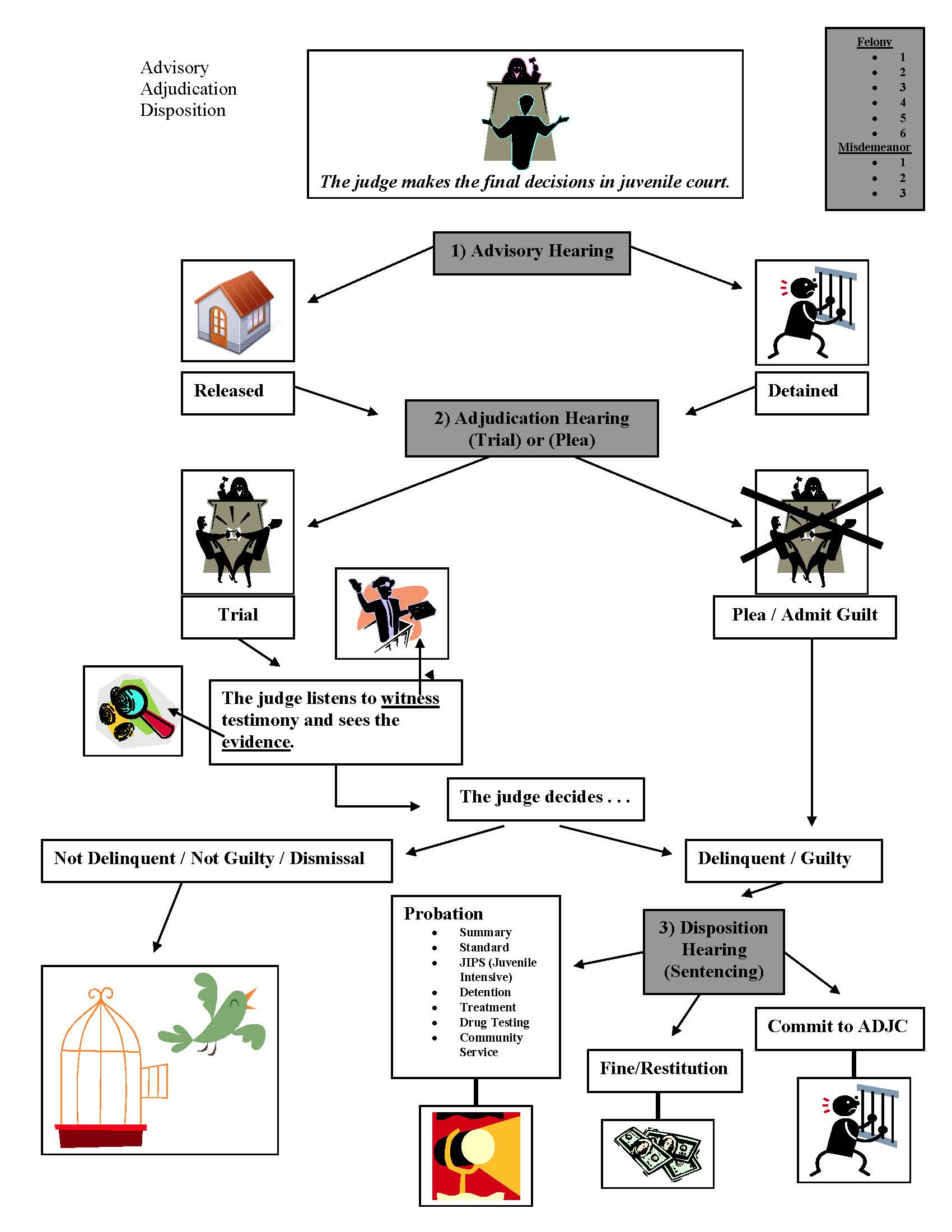
Juvenile Court Process

the-judge

WHY I REALLY DON’T WANT A SECOND FELONY

  1. The best thing that can happen to me is HOUSE ARREST PLUS 32 hours of community service, school work+a minimum of future 30 days of detention time.
  2. The worst place to be in the Juvenile System is ADOBE (no girls!) or Black Canyon (no boys!). There is NO FREEDOM!
  3. Who decides my sentence?
    Me? No
    My parents? No
    My lawyer? No
    My judge? You got it!
    PLUS the prosecutor can file charges in Adult Court
  4. The worst place? ADULT COURT! Where I can get probation with up to A YEAR in JAIL or be sent to adult prison for the REST OF MY LIFE!


What do I get to decide?

The best way to avoid that second felony.

Be clean, sober and aware. NO DRUGS!

Pinal County Youth Justice Center (Detention)

Navajo County Juvenile Restoration Center

WHAT IS PREA?

“The Prison Rape Elimination Act (PREA) of 2003 was established to address sexual abuse and sexual harassment of persons confined to correctional facilities. The provisions of PREA include the development of standards for detection, prevention, reduction, and elimination of sexual abuse and sexual harassment in confinement settings. The Act applies to all public and private institutions that house adult or juvenile offenders.”

Please click on the link, Juvenile Law Forms. For more information on the following:
    •    Eligibility and steps to apply for Set Aside of Juvenile Records
    •    Eligibility and steps to apply for Destruction of Juvenile Records
    •    Direct PDF download links to the application forms
    •    Instructions on what to do after completing the applications

GREENLEE COUNTY
PROBATION DEPARTMENT

 Our Mission

“The Greenlee County Probation Department is committed to enhancing community safety, holding offenders accountable, and supporting positive behavior change through evidence-based practices, supervision, and rehabilitative services. The department also affirms its duty to protect and uphold the rights of victims, ensuring their voices are heard and their interests respected throughout the justice process.”

“The Greenlee County Probation Department is a combined adult and juvenile probation agency serving the Superior Court of Arizona in Greenlee County. Our department promotes community safety, accountability, and opportunities for positive change by supervising individuals of all ages placed on probation and by providing access to supportive services, resources, and interventions. As a rural, community-centered department, we work closely with the courts, local agencies, families, victims, and service providers to ensure fair, consistent, and effective probation practices.”

We are a unified department responsible for supervising both adult and juvenile probationers. Our small, highly dedicated team provides individualized, hands-on supervision and support. Staff include:
  • Chief Probation Officer

  • Chief Deputy Probation Officer

  • Probation Officers (Adult & Juvenile Supervision, cross-trained)

  • Surveillance Officer

  • Financial Officer

  • Secretary / IT Support

Our combined structure allows us to respond quickly to community needs, build strong relationships, and offer seamless services for youth, adults, and families.

Adult & Juvenile Probation Services

  • Standard Probation Supervision

  • Intensive Probation Supervision (IPS / JIPS)

  • Diversion programs and alternatives to detention/incarceration

  • Greenlee County Recovery Court

  • Case planning using risk/needs assessments

  • Behavioral and cognitive programming

  • Accountability and compliance monitoring

  • Community service coordination

  • Victim rights support and restitution tracking

Additional Responsibilities

  • Presentence and predisposition investigations

  • Court reports and recommendations

  • Collaboration with schools, law enforcement, and treatment providers

  • Family engagement and support

  • Monitoring of court-ordered treatment and services

  • Recovery Court – A structured, treatment-focused program promoting sobriety and long-term stability.

  • Evidence-Based Practices (EBP) – Use of validated assessments, motivational interviewing, cognitive-behavioral strategies, and data-driven decision-making.

  • Youth Support & Prevention – Skill-building, early intervention, and family-focused approaches to reduce juvenile recidivism.

  • Community Collaboration – Partnerships with local schools, victim advocates, law enforcement, behavioral health providers, and service organizations.

Irvin Talley
Chief Probation Officer
(928) 965-4185

Probation Offices:

Clifton Office
223 5th Street, Clifton, AZ 85533
 
Duncan Office
1684 Fairgrounds Rd. Duncan, AZ 85534
 
Regular Business Hours
8:00 a.m. to 5:00 p.m.
Monday to Friday
 

Additional Links

OUR COMMITMENT TO THE cOMMUNITY

“Accountability and support go hand in hand. Our approach emphasizes balanced supervision, meaningful consequences, rehabilitative opportunities, and individualized plans designed to help youth and adults succeed. By focusing on long-term behavior change and strong community relationships, we work every day to reduce recidivism and contribute to a safer, healthier Greenlee County.”

ash-peak-range

Greenlee County Government
253 5th St
Clifton, AZ 85533

Monday-Thursday 7am – 5pm

Superior Court Hours: Monday- Friday 8am – 5pm

Greenlee County News & Updates

The latest County news, articles, and resources, delivered to your inbox automatically.

[mc4wp_form id="228"]

© 2023 Greenlee County . All Rights Reserved | powered by Better IT Services